

Garland Beaufort: Pre-built & custom plans, premium, research-backed coaching built around your lifestyle, capability, and budget. Improve: Aesthetics ~ Strength ~ Fitness ~ Mobility ~ Longevity.
Garland Beaufort: Pre-built & custom plans, premium, research-backed coaching built around your lifestyle, capability, and budget. Improve: Aesthetics ~ Strength ~ Fitness ~ Mobility ~ Longevity.
The Problem
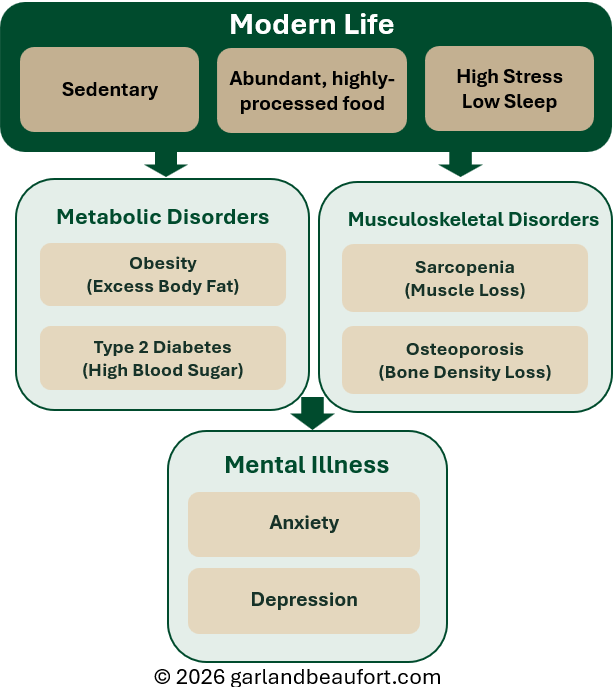
We are living in an era specifically designed to make us sedentary, overfed, undernourished, highly stressed and underslept. It isn’t easy.
-
Constant sitting and eating ultra-processed foods cause obesity (excess body fat) and insulin resistance, which leads directly to type 2 diabetes (high blood sugar). Obesity causes systemic inflammation, making it harder to stay active and further damaging cells.
Metabolic syndrome is now defined medically by having at least three of the following five conditions:
o A large waistline: Abdominal obesity.
o High blood pressure: >130/85 mm Hg or taking medication.
o High blood sugar: Fasting blood sugar > 100 mg/dL or taking medication.
o High triglycerides: Blood fat levels > 150 mg/dL or taking medication.
o Low HDL cholesterol: < 40 mg/dL and 50 mg/dL for men and women respectively or taking medication.
-
Since modern life requires little exertion, adults frequently suffer from sarcopenia (age-related loss of muscle mass and strength) and osteoporosis (weak, brittle bones). Without muscle tissue to absorb glucose, insulin resistance worsens, trapping the body in a vicious cycle. Once people’s strength-to-weight ratio degrades to below 1 (i.e. they are now too weak to lift themselves up), their independence is lost. They can no longer get up out of a chair, take themselves to and from the loo, or pick themselves up from a fall.
-
A lack of movement, poor metabolic health, and low vitamin D from staying indoors heavily contribute to poor mental health, including rising rates of anxiety and depression. When mental health suffers, motivation drops, leading to poorer food choices and less exercise.
Our Solution
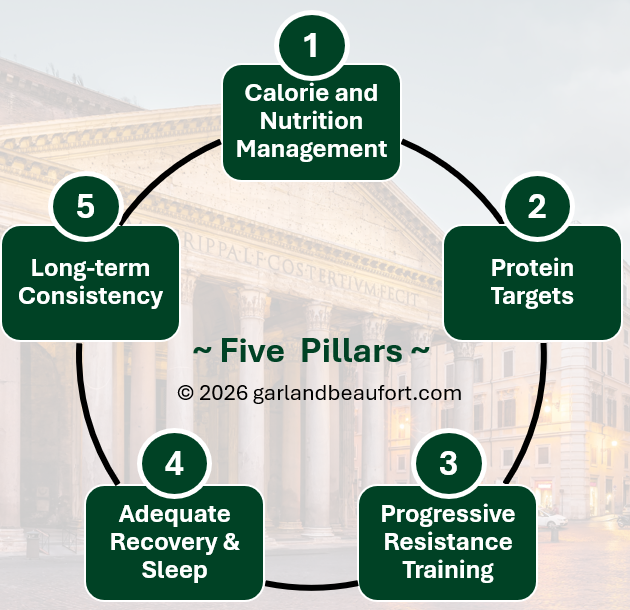
We counteract the problem with our Five Pillars.
Timeless, evidence-based, proven, fitness principles which are woven into each of our programs.
-
When we manage calories, we control the quantity of energy consumed.
When we manage nutrition, we control the quality of energy consumed.
When we manage calories, we control our body fat levels.
When we manage nutrition, we control our essential vitamin and mineral levels. One of the easiest ways to manage our nutrition is simply to eat more unprocessed whole foods: foods in their natural form.
When actively losing body fat (in a calorie deficit phase), we do so within safe limits to avoid muscle atrophy, and we incorporate interspersed maintenance phases to prevent diet fatigue and rebounds.
-
Adequate dietary protein is the essential raw material used to physically build muscle; a process called Muscle Protein Synthesis. Without adequate protein, we simply will not build muscle however hard we train. As the literature suggests, to overcome age-related "anabolic resistance," the clinical gold standard recommends an intake of 1.0 to 1.3 g/kg of target bodyweight/day for older populations, who aren’t active and who aren’t resistance training.
However, for our clients who are resistance training, or undergoing weight loss, this requirement is 1.4–2.0 g/kg of target bodyweight/day.
-
We aim for roughly 5-10 weekly working sets of 5-25 reps, at an effort of 7-10 out of 10 per muscle group. We do this in good form, progressing weight and/or reps when we can (if the rep ain’t slowing, the muscle ain’t growing).
We normally look to incorporate the six core multi-joint movement patterns into our weekly workout schedules: vertical push, vertical pull, horizontal push, horizontal pull, squat, hip hinge. We also use targeted single-joint movement patterns such as the calf raise, tricep extension, bicep curl, and lateral raise.
Muscle & bone will grow regardless of age; they will grow and become stronger if stimulated to grow and fed with sufficient protein.
-
We train to adapt, not to exhaustion.
Adequate rest, recovery, and sleep are essential. Lack of restorative sleep is a huge impediment to muscle growth, repair, and body fat metabolism. Overtraining, under-recovery and poor sleep negatively affect physical performance and inhibit muscle growth and repair; not to mention the negative impact they have on our mood.
Approximately eight hours’ sleep per night appears to be the benchmark to aim for. In terms of recovery, we prefer to allow 48 hours before training the same muscle group again; this allows for adequate recovery and adaptation to occur without interruption.
-
We can’t reliably wait for the necessary motivation or willpower to start and, more important, to continue something. Motivation and willpower are fleeting and untrustworthy companions.
Around 2,400 years ago, Aristotle said that we acquire a particular quality by consistently acting a particular way; that we become what we repeatedly do. He suggested that becoming good at something was not the result of an act, but the result of the habit formed by repeated acts.
What works, therefore, are our systems: processes we and our coaches implement that make those acts and the resulting habits automatic, requiring little thought.
In summary, all profound change to the body, using diet and exercise protocols, is anchored in long-term consistency i.e. regular habits over a sustained duration. We weave these habits into the very fabric of clients’ lives rather than try to embark on sporadic, ephemeral, fitness ‘journeys’ where ‘normal’ life is temporarily disrupted and subjugated.
-
Whilst we are principle driven, we are method agnostic; meaning how you decide to meet these principles – the methods you adopt – must be aligned with your personal choice.
While social media and modern media platforms are replete with short-lived fads, fitness gurus, and intense dietary tribalism and dogma, we choose a different path. We prefer to remain entirely method agnostic, yet faithful to our principles. We know that while fitness trends come and go, the fundamental principles of body fat metabolism and human physiology never change. We prefer to quieten the noise, disengage from dogma, and deliver concrete, data-driven protocols tailored entirely to your reality and lifestyle.